

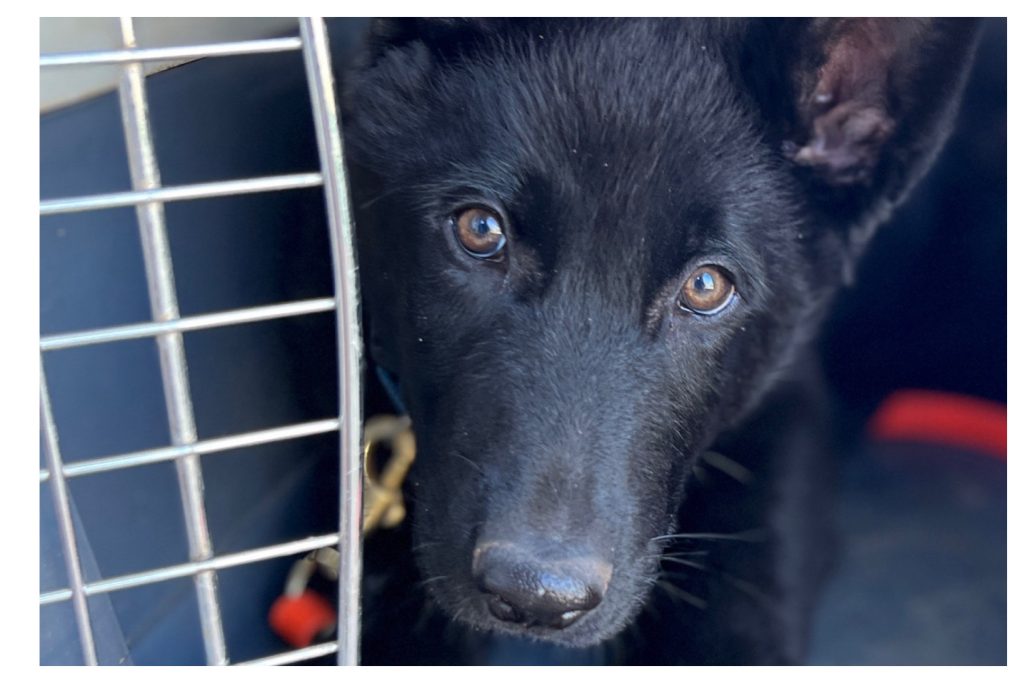
Short answer: Crate training works when the crate predicts good things and quiet earns the door. Feed every meal in the crate, close the door for seconds before building to minutes, and try not to open it mid-protest — wait for a gap of silence and open on that. The exception matters: a puppy who needs to eliminate, or who is in genuine distress, comes out regardless. Most puppies stop protesting within two to four weeks.
It’s 2am. The puppy is screaming. You’re standing in a dark hallway wondering whether you’re being cruel or being played, and every article you’ve opened tonight has told you to “be patient” without telling you what patient actually looks like.
Here’s what it looks like, with numbers.
Crate training is the process of conditioning a puppy to treat a crate as a safe resting place rather than a confinement. It isn’t about getting the puppy into the box. It’s about what the box predicts. Get that right and the crate becomes the place your dog chooses to nap in with the door wide open. Get it wrong and you spend a year fighting a dog at bedtime.
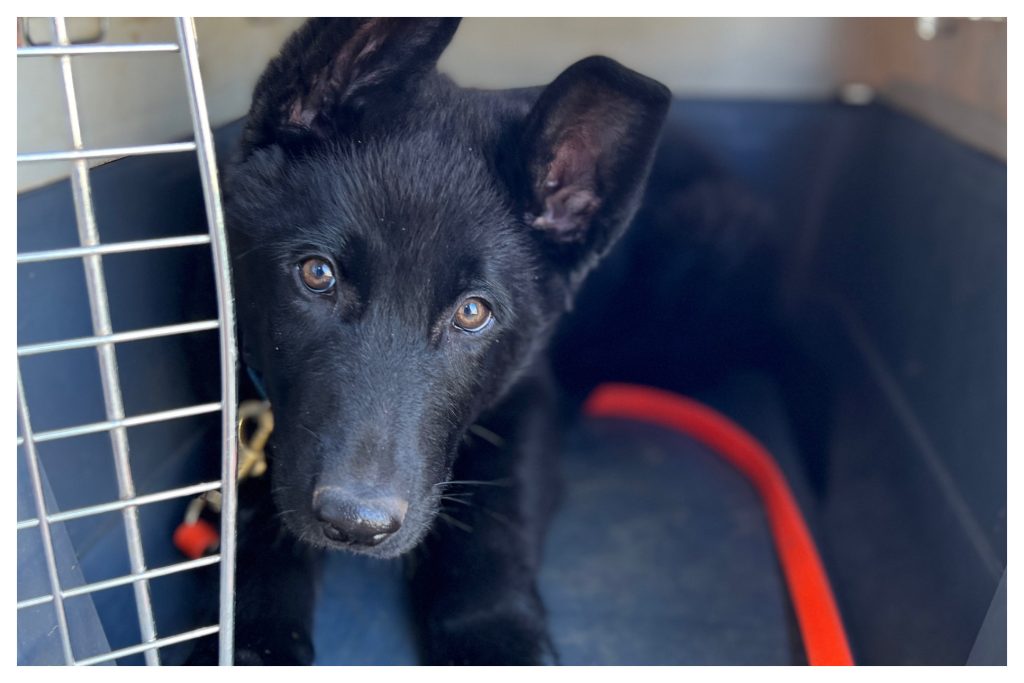
In January 2024 we took in an eight-week-old black German Shepherd named Babe and wrote down every day of his training as it happened. What follows includes his actual confinement numbers — how long he protested, how fast that dropped, the day it stopped, and the day he had an accident in there anyway. Not a guess. A record, including the parts that didn’t go to plan.
What’s in this guide
- Why does crate training work at all?
- What size crate does your puppy need?
- Where should you put the crate?
- How do you introduce the crate on day one?
- What do you actually do on the first night?
- Why shouldn’t you open the door when your puppy cries?
- How do you tell protest from a real need?
- How long does the crying actually last?
- How long can a puppy hold it in a crate?
- What does a realistic crate day look like?
- What should go in the crate — and what shouldn’t?
- What if your puppy soils the crate?
- Why did crate training suddenly get worse?
- The 7 mistakes that break crate training
- When can your puppy stop using a crate?
- Frequently asked questions
Why does crate training work at all?
Because dogs repeat whatever gets them something they want and drop whatever stops working. That’s not a dog thing — it’s how learning works in every animal with a nervous system. Same principle that gets a six-ton killer whale to hold still for a voluntary blood draw. Same principle running in your kitchen tonight — and the same one behind puppy recall training, the other behavior worth getting right this month.
So a crate isn’t a box you put a puppy in. It’s a prediction. Every time your puppy goes in and something good happens — food appears, a chew appears, nothing scary occurs — the prediction gets stronger. Every time something bad happens — you leave for nine hours, the door shuts right as the fun ends, they get sent there as punishment — it gets weaker. That’s the whole method. Everything below is how to stack those predictions in the right order.
And crates earn their keep beyond bedtime. A dog who is genuinely comfortable in one travels better, recovers from surgery better, and handles a night at the vet without falling apart. You’re not training a bedtime routine — you’re training a life skill your dog uses at the worst moment of their life.
What size crate does your puppy need?
Big enough to stand up without ducking, turn around without touching the sides, and lie fully stretched out. That’s it. Anything bigger and you’ve created a bedroom and a bathroom.
That’s the whole reason size matters. Dogs avoid soiling where they sleep — one of the few instincts you get for free. But give the crate a far corner and that instinct switches off, because now there’s a spot that isn’t the bed.
| Adult weight | Crate size | Typical breeds |
|---|---|---|
| Up to 25 lb | 24″ | Frenchie, Boston Terrier, Miniature Dachshund |
| 26–40 lb | 30″ | Beagle, Cocker Spaniel, Corgi |
| 41–70 lb | 36″ | Border Collie, Australian Shepherd, Husky |
| 71–90 lb | 42″ | Labrador, Golden Retriever, Doberman, German Shepherd |
| 91 lb+ | 48″ | Rottweiler, Great Dane, Mastiff |
Buy for the adult dog and use a divider. A puppy-sized crate you replace at six months means retraining in a brand-new box. Get the adult size, block off the back with the divider panel, and move it back a few inches every couple of weeks.
Where should you put the crate?
In the room where you sleep, for the first two to three weeks. Not the laundry room, not the garage, not the far end of the house where you can’t hear them.
This is the single change that fixes most first-week disasters, and people resist it because they think proximity creates dependence. It’s the opposite. An eight-week-old has just been pulled from a pile of littermates they’ve slept against every night of their life. Total isolation on night one isn’t training — it’s a shock, and shocked animals don’t learn well. Put the crate beside your bed where they can hear you breathing, then move it a few feet a night once they’re sleeping through.
How do you introduce the crate on day one?
You don’t shut the door. Not on day one, and not until the puppy is walking in on their own.
Day one — steps 1 to 3. Don’t rush past these.
- Take the door off, or prop it fully open. A door that swings and bumps them on the way in can undo a week of work in one second.
- Feed every meal inside. Bowl at the back, puppy walks in, eats, walks out. Do nothing else. Their food is the strongest tool you own — use it in there instead of on the kitchen floor.
- Salt it. Between meals, drop a piece of kibble in when the puppy isn’t looking. They should keep finding out that the crate randomly pays.
Once they’re walking in on their own — usually day two or three — steps 4 and 5.
- Close the door for three seconds. While they’re eating, swing it shut, then open it before they finish. Build to ten seconds, then thirty, then a minute — always opening before they think to ask.
- Feed through the closed door. Once the door can stay shut for a minute, sit beside it and post kibble through the bars. Now the closed door predicts food too.
What you’re looking for is the moment it clicks — the puppy stops being led in and starts driving in. With Babe it looked like this by day six:
From the training log
“He runs in, spins and sits. Then you close the door and feed him hot dog. He’s a happy little camper in there.”Babe · Day 6 · 8 weeks 5 days old
Runs in, spins, sits. That’s a finished crate behavior in nine words, and it took under a week — because nobody shut a door on him before he was ready for it.
What do you actually do on the first night?
Here’s the sequence. It’s boring on purpose.
- Pick up the water about two hours before bed. Not all day — just the last stretch. A puppy who drinks at 10:30pm is waking you at 1am.
- Burn some energy, then let them settle. Play, then twenty quiet minutes. A puppy who goes into the crate wired stays wired.
- Last potty trip immediately before the crate. Outside, boring, no play. Wait for the full job — most puppies need to go twice.
- In the crate, lights out, no ceremony. No long goodbye. Long goodbyes tell the puppy something worth worrying about is happening.
- Expect noise, and wait it out. This is the part everyone gets wrong, and it’s covered in full below.
- Set an alarm for one middle-of-the-night trip. Yes, deliberately. Waking them on your schedule beats being woken on theirs, and it means the trip isn’t a reward for screaming.
- Middle-of-the-night trips are business only. Outside, potty, straight back in. No talking, no play, no lights if you can manage it. If 2am becomes fun, 2am becomes permanent.
One night does not tell you anything. Night one is almost always the worst night, and people make enormous decisions based on it — buying a different crate, giving up entirely, letting the puppy into the bed. Judge this on night four, not night one.
Why shouldn’t you open the door when your puppy cries?
Because the door opening is the reward, and whatever your puppy is doing the moment it opens is the thing you just paid for.
This is the one rule we hold hardest. From the log, day four:
From the training log
“One of our rules is if the puppy yells we don’t respond. 100% of the time.”Babe · Day 4 · 8 weeks 3 days old
But “don’t respond” is only half of it, and the half everybody quotes is the less useful half. Here’s the mechanic that actually does the work:
From the training log
“He hit a 30 second span of no noise and that was my cue to get him out.”Babe · Day 4 · 8 weeks 3 days old
Read that again, because it’s the difference between this working in four days and dragging on for two months. You are not ignoring your puppy. You are timing the release to silence.
Ignoring is passive and teaches nothing. Timing the release is active — you’re standing there paying attention, waiting for a gap, and the instant it appears you open the door. Thirty seconds of quiet at first; by day seven with Babe we were opening on five, because five seconds of deliberate quiet from a puppy one day short of nine weeks is a real decision, and real decisions are what you want to pay for.
The puppy doesn’t need to understand any of this. They just need the pattern to be clean: protest alone never opens the door — a real need always does. Which brings us to the part most crate advice skips.
How do you tell protest from a real need?
This matters more than any other paragraph on this page, and most crate advice skips it entirely.
“Never respond to crying” is dangerous advice if you apply it blindly, because a puppy who genuinely needs to eliminate and gets ignored will eventually soil the crate — and once a puppy learns they can soil where they sleep, you have undone the one instinct that makes crate training work in the first place.
So we don’t ignore crying. We read it.
| What you’re hearing | Likely meaning | What to do |
|---|---|---|
| Starts within minutes of going in, rhythmic, rises and falls in waves | Protest. They want out, not relief. | Wait for a gap and open on it — but see the time limit below. |
| Starts after a stretch of sleep, escalating, restless, circling | Bladder. This is a real need. | Take them out. Business only, straight back in. |
| First thing in the morning, urgent | Bladder, every time | Go. Don’t make them wait for silence at 7am. |
| Escalating rather than settling, can’t calm down even once released, panting, drooling, bar-biting, damaged nails or teeth | Possible distress, not protest | Stop. Rule out heat first — uncover the crate, check the room. Then back up several steps. See the box below. |
| Sudden crying from a puppy who had been fine for weeks | Check for a physical cause first | Rule out illness or injury before treating it as training |
My own note on Babe’s morning noise, day seven: “He was very noisy but that as always it is a full bladder issue.” That’s not a training failure. That’s a puppy telling you something true, and the right response is a trip outside, not a lesson.
Put a clock on it. “Wait for a gap” is not the same as “wait indefinitely.” At eight to ten weeks, if you haven’t got a usable gap within about ten to fifteen minutes, stop waiting — take them out for a potty trip, then back the training up a step. You almost certainly asked for more duration than the puppy could give. Waiting longer doesn’t teach patience; it teaches them the crate is where nobody comes.
When to stop and get help. Frantic, sustained panic with no gaps — drooling, bent bars, broken teeth or nails, injuring themselves trying to escape — is not stubbornness and it will not improve by waiting longer. That’s a distress response, and it needs a different plan and often a veterinary behaviorist. If your puppy is hurting themselves, stop crate training and talk to your vet.
How long does the crying actually last?
Most articles give you a range somebody made up. Here’s a real curve from a real puppy instead.
One thing to be straight about before you read it: these are confinement protest numbers, logged across the day — crate and outdoor kennel, mostly after morning meals — not a stopwatch held to overnight screaming. The pattern is what transfers, not the specific setting. This is Babe, eight weeks old on day one, black German Shepherd, brand new to us:
| Day | Age | Confinement protest |
|---|---|---|
| 1 | 8w 0d | First crate reps in training. “He was phenomenal with crating!” |
| 2 | 8w 1d | Yelled for under 3 minutes after going back in following breakfast |
| 3 | 8w 2d | Yelled for under 30 seconds. Three minutes to thirty in 24 hours |
| 4 | 8w 3d | Breakthrough — door closed and opened without him breaking out |
| 6 | 8w 5d | Running in on his own, spinning, sitting |
| 7 | 8w 6d | Slept 9 hours overnight. Release window down to 5 seconds of quiet |
| 8 | 9w 0d | “I had to literally wake him up he was out so deeply” |
| 22 | 11w 0d | “His squawking is becoming less pronounced” |
| 25 | 11w 3d | No whining at all — protest extinguished, 25 days in |
| 26 | 11w 4d | “No squeaks whatsoever” |
| 28 | 11w 6d | Urinated in his crate. After a 1.5 mile walk and a lot of water the night before |
That last row is in there on purpose. Twenty-eight days in, three days after the crying stopped for good, a professionally trained puppy on a strict routine still had an accident in his crate — because he’d had a big drink after a long walk the evening before. It wasn’t a training failure and it wasn’t a setback. It was a full bladder and a long night. If it happens to you on day thirty, you haven’t broken anything.
Two things to take from that. One: the steep part happens fast. Three minutes to thirty seconds took a single day — most of the pain you’re dreading is a 72-hour problem, not a six-week problem. Two, and this matters more: the tail is long, and that’s normal. Babe was sleeping through by day seven and still squawking at eleven weeks. If you’re on day fifteen and there’s noise, you haven’t failed. You’re on the curve.
Read this before you copy the nine-hour number. Nine hours overnight at nine weeks is exceptional — it is not the standard and you should not plan for it. Most puppies that age need at least one middle-of-the-night trip, and many need two. Babe was on a strict daily routine with full elimination immediately before bed, in a professional program, and even he peed in his crate at eleven weeks. Aim for the routine, not the number. A puppy forced to hold it past their capacity will soil the crate — and that costs you far more than a broken night’s sleep.
Want the rest of Babe’s first two weeks?
The free Puppy Training Secrets library covers setup and week one, potty training, biting and chewing, crate training, leash work, socialization and recall — the ebook plus 13+ training videos. No credit card, no catch.
Send me the free ebook + videos → Free · Instant access · From former SeaWorld animal trainersHow long can a puppy hold it in a crate?
You’ll see “one hour per month of age, plus one” quoted everywhere. We think that’s too generous for very young puppies — it would have you crating an eight-week-old for three hours. The table below is deliberately tighter, and it’s a ceiling, not a target.
| Age | Daytime maximum | Realistic overnight |
|---|---|---|
| 8–10 weeks | About 1 hour | 3–4 hours, 1–2 trips out |
| 11–14 weeks | About 2 hours | 4–6 hours, usually 1 trip |
| 15–16 weeks | About 3 hours | 6–7 hours, often none |
| 17+ weeks | About 4 hours | 7–8 hours |
| 6 months+ | 4–5 hours | Through the night |
Overnight stretches beat daytime stretches because a sleeping puppy produces less urine and isn’t moving around — which is why a nine-week-old who manages an hour awake can do three or four asleep.
No puppy under six months should be crated for a full workday. If your schedule requires it, you need a midday visitor or a puppy-proofed pen instead — and that’s worth solving honestly before the puppy comes home, not after.
What does a realistic crate day look like?
Babe’s log has almost the same shape on every page, and the shape is the point — puppies settle into rhythm far faster than they settle into rules. This is his, with crate times sized for a puppy of about twelve weeks. If yours is eight to ten weeks, halve the closed-door stretches and add potty trips.
| Time | What happens | Crate? |
|---|---|---|
| 7:00–7:30am | Out of the crate, straight outside, potty | Out |
| After potty | Play, then breakfast — fed in the crate | In, door open |
| Mid-morning | Nap. Puppies need 18–20 hours of sleep a day | In, closed, ~1–2 hrs |
| 11:00am | Session 1 — short, 2 to 5 minutes | Out |
| Midday | Potty, then nap | In, closed, ~1–2 hrs |
| 4:00pm | Session 2, then free time with supervision | Out |
| 5:30–6:00pm | Dinner in the crate, then nap | In |
| Evening | Walk and calm time with the family. Water up ~2 hrs before bed | Out |
| Bedtime | Full potty trip, then in with no ceremony | In, door closed |
Notice how much of the day is naps. An overtired puppy looks exactly like a badly behaved puppy — biting, frantic, ignoring you — and the crate is the fix, not the punishment. If your evenings are chaos, the answer is very often an afternoon nap you skipped.
What should go in the crate — and what shouldn’t?
In: a flat, chew-resistant mat or bare tray. One safe chew for settling — something they can’t destroy and swallow. That’s the list.
Out, and this part is safety rather than preference:
- Collars, harnesses and tags. Take them off. Tags and buckles catch on crate bars and dogs have strangled that way. This is the single most important line in this section.
- Plush beds and blankets, at first. Beautiful, and a swallowed-stuffing emergency surgery waiting to happen with a teething puppy. Earn them later.
- Water bowls, overnight. Fine for long daytime stretches. Overnight they just buy you a 2am wake-up.
- Rawhide or anything they can break a piece off of. Unsupervised chewing is how puppies choke.
- Puppy pads. Putting a toilet in the bedroom teaches the exact thing you’re trying to prevent.
What if your puppy soils the crate?
It means one of five things, and none of them is that your puppy is dirty or spiteful.
- The crate is too big. The most common cause by a distance. Fit the divider.
- They were in there too long. Check the table above and be honest about the number.
- They didn’t fully empty before going in. Most puppies go twice. Wait for the second one.
- The smell is still there. Ordinary cleaners don’t remove it for a dog. Use an enzymatic cleaner — anything else leaves a marker that says “this is the spot.”
- There’s a medical reason. Sudden soiling in a previously clean puppy means a vet visit, not a training change. Urinary infections are common in puppies and no amount of protocol fixes one.
From the training log
“Babe was awesome this morning but he did urinate a little in his crate. I think it was because had a lot of water after the 1.5 mile the evening before.”Babe · Day 28 · 11 weeks 6 days old
Cause number two, in other words — too long for what was in him. Note what didn’t happen: no punishment, no change to the crate, no conclusion that the training had broken. Just a look at the evening before, and on with the day.
Never punish a puppy for soiling a crate. All that teaches is to hide it — and a dog who hides elimination is a much harder problem than one who doesn’t.
Why did crate training suddenly get worse?
Because something changed, and it’s almost always one of these five.
| What you’re seeing | What’s actually happening | What to do |
|---|---|---|
| Was fine, now cries again around 4–6 months | Teething discomfort, and the front edge of adolescence | Ride it out, add a safe chew, don’t change the rules |
| Fine at night, refuses during the day | The crate now predicts you leaving | Crate them while you’re home, constantly, for nothing |
| Got worse after a vet visit or boarding | A bad association attached to confinement | Back to feeding meals in there with the door open |
| Started refusing to go in at all | Something happened in there you didn’t see | Rebuild from step one. It’s faster than it sounds |
| Fine for you, screams for your partner | Only one person trained the routine | Everyone runs the same sequence for two weeks |
The fix is nearly always the same and it’s nearly always faster the second time: put the food back in the crate, drop the duration back to seconds, and rebuild. You’re not starting over. You’re doing maintenance.
The 7 mistakes that break crate training
- Using the crate as punishment. One angry “get in your crate” undoes a week. The crate can never be where bad things happen.
- Opening the door during the noise. You just paid for the noise. Wait for the gap.
- Only crating them when you leave. Now the crate means abandonment. Crate them while you’re sitting ten feet away, often.
- Buying a crate that’s too big. You’ve built a bathroom.
- Making the middle-of-the-night trip fun. Business only. No lights, no talking, no play.
- Going too fast on day one. Shutting the door before they’re walking in willingly costs you a week to buy an hour.
- Quitting on night two. Night one and night two are the worst nights you will ever have. The curve above starts breaking on night three.
If you’ve done four of these, welcome — so has everyone reading this, including us with our first dog. None of it is permanent.
When can your puppy stop using a crate?
When they’ve gone about two months with no accidents and nothing destroyed, and they’re past the worst of adolescent chewing — usually somewhere between twelve and eighteen months for most dogs, later for the big working breeds.
Then test it in stages, not all at once. Ten minutes loose while you’re home. An hour. An evening. One room behind a baby gate before the whole house. If something gets chewed, you went too fast — back up a stage and try again in a few weeks.
Off-leash freedom is a separate question, and it rests on one behavior — a recall your puppy answers every time. Build that before you widen the boundaries. And if the word is already worn out — your dog hears it and keeps walking — that is a different repair job, covered in my dog won’t come when called.
Plenty of dogs never fully stop, and that’s fine. A dog who genuinely likes their crate has a bedroom, not a cage. Take the door off, leave it open, and watch where they choose to sleep.
Frequently asked questions
Should you cover a puppy’s crate with a blanket?
It helps a lot of puppies settle by cutting visual stimulation, and it’s worth trying on night one. Leave one side open for airflow, and don’t use it if your puppy pulls the blanket through the bars and chews it.
Is it cruel to crate a puppy?
Crating a puppy for too long, or using the crate as punishment, is unfair. A properly introduced crate isn’t. You’ll often read that dogs are “den animals” — the evidence for that is thin, and it isn’t the reason this works. It works because the crate has been conditioned to predict good things. The test is simple: a well-crate-trained dog walks in on their own when the door is standing open. Babe was doing that on day six.
Where should the crate go at night?
Your bedroom, for the first two to three weeks. Then move it a few feet per night toward wherever it will live. Isolation on night one makes the first week much harder than it needs to be.
How long does crate training take?
The hardest part is usually over in 72 hours. Full extinction of the protest crying took Babe about 25 days. Expect two to four weeks to a genuinely settled puppy, with the steepest improvement in the first three days.
Should you put water in the crate overnight?
No for overnight — it buys you a middle-of-the-night wake-up. Yes for long daytime stretches, using a clip-on bowl rather than one that tips.
What if my puppy screams for hours and never stops?
Hours with no gaps at all is not ordinary protest. Check for a physical need first, then back the training up several steps — door open, meals inside, seconds not minutes. If your puppy is panting, drooling, or hurting themselves trying to get out, stop and talk to your vet.
Can you crate train an adult dog?
Yes. The protocol is identical — feed meals inside, build duration in seconds, never open on noise. Adults usually take longer than puppies because they may have existing associations to undo, but conditioning doesn’t care about birthdays.
Should the crate be in the bedroom forever?
No, unless you want it there. It starts in the bedroom because that’s what makes week one survivable. Once your puppy is sleeping through, move it gradually to wherever it fits your household.
Tonight, do three things.
Pick up the water two hours before bed. Feed dinner inside the crate with the door open. And when the noise starts, stand there and wait for the gap instead of opening on the scream.
That’s it. That’s night one. You don’t need a different crate, a special blanket, or more patience than you already have — you need to pay for the right half-second, and the right half-second is the quiet one.
Babe went from three minutes of protest to thirty seconds in a single day. He wasn’t doing anything an ordinary puppy can’t do — the method wasn’t special, and it isn’t complicated. He just had someone standing there waiting for silence instead of reacting to noise. You can be that person tonight.
You can do this.
The crate is step one. Recall is the one that saves their life.
The Whistle Recall Course is 22 video lessons filmed with a real puppy — the same conditioning method, applied to the one command that matters most when a door gets left open. New to it? Start with the free guide to puppy recall training.
See the Whistle Recall Course → Instant access · Works on phone, tablet & computer · Lifetime accessKim and Zahid Buttar spent over 20 combined years as marine mammal trainers at SeaWorld, conditioning killer whales, dolphins, sea lions, walruses, belugas, otters and seals — animals you cannot leash, force, or bribe into cooperating. They now teach everyday puppy owners the same force-free, marker-based methods through Elite Puppy Training in Lake Norman, North Carolina. Babe’s full 39-day training log is published day by day here.
 Free — no card, no catch
The ebook + 13 training videos. Free.
Puppy Training Secrets and the full video library, from former SeaWorld trainers. Biting, whining, crate, recall — handled.
Get both free →