

Short answer: Your dog isn’t stubborn. The word “come” has stopped predicting anything good, so it’s been filed as background noise — a poisoned cue. You don’t fix that by saying it louder. You retire the old word, teach a brand-new cue your dog has no history with, pay it every time for two weeks straight, and only then add distance and distraction. Most dogs answer a fresh cue reliably in 3 to 6 weeks.
You’re standing in the yard in your socks. You’ve said his name four times. He heard all four — you watched his ear twitch on the second one — and he’s still nose-down in the fence line like you’re a podcast playing in another room.
That’s not defiance. That’s data.
A poisoned cue is a command your dog has learned predicts something worse than whatever they’re already doing. Every time “come” was followed by a bath, a leash clip, the end of the park, or an irritated human — and every time it was followed by nothing at all — it got a little cheaper. Say it enough times with no payoff and it stops being a cue. It becomes weather.
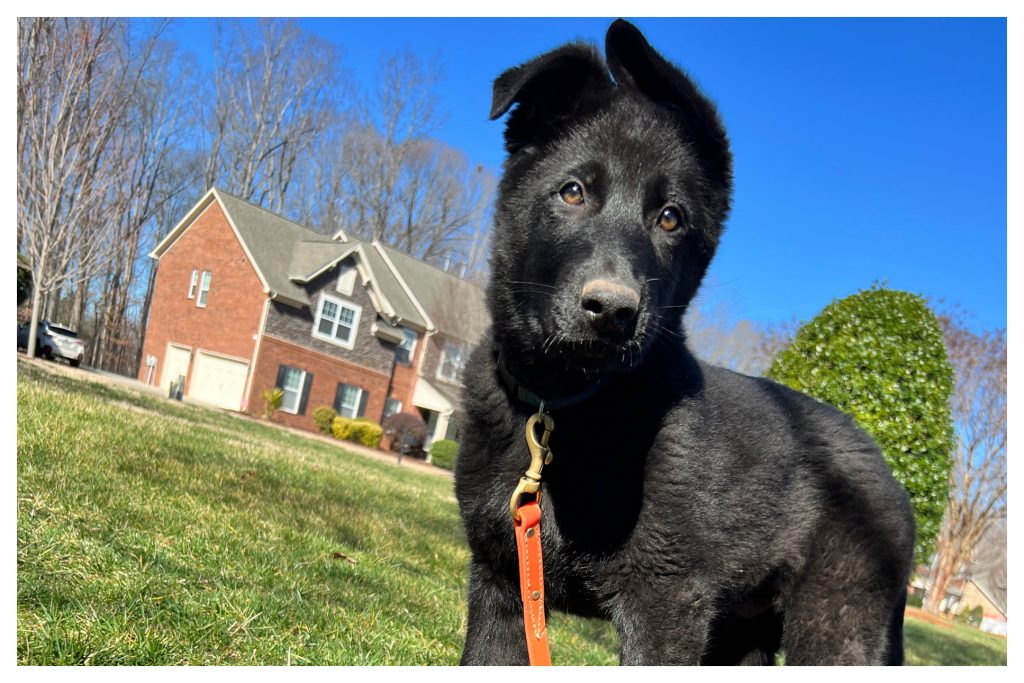
Here’s the good news, and it’s better than it sounds: dogs don’t hold grudges about vocabulary. A burned word can’t be scrubbed clean, but a new one can be built from zero in a few weeks. We’ve done it with a six-ton killer whale who had every reason to ignore a human, and we’ve done it with a black German Shepherd puppy named Babe whose whole training was written down as it happened.
In January 2024 we took in Babe, an eight-week-old male from Kennel Von Weise, for a 39-day resident program and logged every single session — including the day his recall failed in the street. What follows is the protocol, and his actual results, failures included.
What’s in this guide
- Why won’t my dog come when called?
- What is a poisoned cue?
- Is your cue poisoned, or was it never really trained?
- What are the 8 things that poison a recall?
- Why does calling your dog to end the fun break “come” fastest?
- Why shouldn’t you repeat the word?
- What should you do the second your dog ignores you?
- Should you ever chase your dog?
- How do you rebuild a burned recall?
- Step 1 — How long do you have to retire the old word?
- Step 2 — Why is a whistle the best replacement cue?
- Step 3 — How do you charge a new cue from zero?
- Step 4 — How do you add distance without breaking it again?
- Step 5 — What do you pay, and for how long?
- Why should you never test your dog?
- What do you do on the day it fails anyway?
- How long does it take to fix a poisoned recall?
- What if my dog only ignores me outside?
- The 6 rules that keep a rebuilt recall clean
- Frequently asked questions
Why won’t my dog come when called?
Because coming to you currently loses a cost-benefit comparison your dog is running in real time, every time.
Dogs do what pays. That’s not cynicism, it’s just how learning works in anything with a nervous system — a sea lion, a Border Collie, a nine-week-old German Shepherd standing in your kitchen. Every behavior is competing against every other available behavior, and the one that has paid best recently wins.
So when your dog blows you off, hold the word “stubborn” and ask a colder question: what has “come” actually paid, lately? For most dogs the honest answer is a short list — a leash clip, a bath, a car ride home, a hand grabbing a collar, or nothing at all. Meanwhile the fence line pays in rabbit scent every four seconds.
You are not losing to disobedience. You are losing to a squirrel, on merit.
Which means the fix isn’t authority. It’s economics. Make the cue the best-paying thing in the environment and the argument ends — the same way it ends with a recall taught properly from day one, which is what puppy recall training covers if you’re starting fresh rather than repairing.
What is a poisoned cue?
A poisoned cue is a signal that has been paired with both good and bad outcomes, so the animal no longer trusts what it predicts. The term comes out of the clicker-training world — behavior analyst Jesús Rosales-Ruiz and the late Karen Pryor put it on the map — and once you’ve seen it you can’t unsee it.
Here’s the part people miss. A poisoned cue is not the same as a weak cue. A weak cue means the dog doesn’t know it well enough. A poisoned cue means the dog knows it perfectly and has decided it’s bad news.
You can see the difference in the body. A dog with a weak recall looks blank — head cocked, nothing happening. A dog with a poisoned recall reacts: a freeze, a lip lick, a slow arc that ends three feet out of arm’s reach, a sudden fascination with sniffing the ground. That’s not confusion. That’s a dog who understood you completely and has made a different call.
And the mechanism is boring, which is why it’s so easy to do by accident. It takes maybe six to ten bad pairings for most dogs. Six times you called him at the park and left. Six times you called him and clipped the leash. That’s a weekend.
Is your cue poisoned, or was it never really trained?
Worth ten minutes of honesty, because the two problems have different fixes. Run your dog through this table.
| What you see | Never trained | Poisoned |
|---|---|---|
| Response in the kitchen, no distractions | Inconsistent | Fast and happy |
| Body language when you say the word outside | Neutral, blank, or distracted | Freeze, look away, sniff, lip lick, shake off |
| Speed of approach | Wanders in whenever | Wide slow arc, stops out of reach |
| Has the word been repeated a lot? | Not especially | Constantly, often louder |
| What usually happened right after? | Varies, nothing memorable | Leash, bath, crate, going home, scolding |
| Comes to a different sound (kissy noise, food bag) | Also unreliable | Instantly and enthusiastically |
That last row is the tell. If your dog ignores “Rocky, come!” and then teleports across the yard when a treat pouch crinkles, nothing is wrong with his hearing, his brain, or his relationship with you. One specific word has been devalued. That’s a repair job, and it’s a fast one.
If he’s unreliable to everything, you don’t have a poisoned cue — you have an untrained recall, and you should start at the beginning instead of the middle.
What are the 8 things that poison a recall?
Ranked by how much damage they do per repetition, worst first. Most owners are doing at least three.
- Calling your dog to end something they love. Park’s over, come. Every rep teaches that the word means the fun stops.
- Calling your dog to do something they hate. Nail trims, baths, ear drops, the vet. One of the fastest ways to burn a word permanently.
- Calling when you can’t back it up. Off leash, forty yards out, a rabbit in play. You are gambling with the cue and the house always wins.
- Repeating it. “Come. Come! COME!” This teaches that the first one is optional and the real cue is the fourth one, delivered angry.
- Punishing the dog when they finally arrive. They did the thing. Late, but they did it. Scold them and you punished the arrival, not the delay.
- Grabbing the collar. A hand shooting toward the neck is unpleasant for a lot of dogs. Do it enough and they’ll come to two feet and no closer.
- Using it as a general-purpose attention noise. If “come” means come here, look at me, stop that, and get out of the trash, it means nothing precise.
- Chasing. To most dogs this is a game with rules, and the rules say stay just out of reach.
Read that list back and notice what it has in common: none of it is the dog’s doing. Which is the good news, because it means all of it is inside your control.
Why does calling your dog to end the fun break “come” fastest?
Because it’s the one mistake that’s perfectly reliable. The dog gets a clean, unambiguous signal every single time: this word ends good things.
Think about the average dog park visit. Forty-five minutes of the best sensory experience of the week, and then one word — and the leash goes on and it’s the car. Do that three Saturdays running and you’ve built a beautiful little conditioned response. It’s just pointed the wrong way.
The fix costs nothing. Call your dog ten times per outing and let them go again nine of them. Call, pay, release — “go play.” Now the word predicts a snack and freedom, and the one time it does mean leaving is statistically invisible.
Then stop putting the leash on at the moment of arrival. Call, pay, take three steps away, then clip. Tiny gap, big difference: the leash stops being the consequence of coming.
Try this tonight. Before the next walk ends, call your dog to you five times inside the last ten minutes and release them every time but the last. Five reps, one outing. That’s the single highest-value thing on this page and it costs you nothing.
Why shouldn’t you repeat the word?
Because every unanswered repetition teaches your dog that the cue is a suggestion with a snooze button.
There’s a real mechanism here, not just etiquette. A cue works by predicting reinforcement. Say it once, nothing happens, say it again, nothing happens, say it a third time and eventually the dog drifts over — and what you just trained is a chain: ignore, ignore, ignore, respond. That’s now the behavior. The third “come” is the actual cue, and the first two are noise your dog has learned to sit through.
The rule is one cue, then act. Say it once. If you get nothing, you don’t say it again — you close the distance, make yourself interesting, get the dog moving toward you by any friendly means, and then pay them anyway.
Yes, pay them anyway. It stings. Do it. You’re not rewarding the delay — you’re protecting the word, and the word is the asset.
What should you do the second your dog ignores you?
Nothing loud, and nothing physical. This is the moment that decides whether the cue survives, and Babe’s log has the cleanest statement of it we’ve ever written down:
From the training log
“When puppies get distracted it’s extremely important not to force them to do anything. You must wait them out until they give you their attention again. Then you pick up as if nothing happened.”Babe · Day 11 · 9 weeks 3 days old
Wait them out. Then pick up as if nothing happened. No lecture, no sigh, no “seriously?” — because your dog reads all of it, and none of it makes the word more valuable.
And whatever else you do, don’t reel them in:
From the training log
“Under NO circumstances should you yank your puppy.”Babe · Day 3 · 8 weeks 2 days old
A leash pop after a failed recall is the fastest poisoning there is, because it arrives at exactly the moment the dog is thinking about the word. Long line, gentle pressure, walk toward them, make it easy — fine. Yanking, never.
The same logic runs in the other direction too, which is the part that catches people out. What you do in the seconds after any cue is what the cue comes to mean:
From the training log
“If you give him any attention like ‘oh poor baby’ and reach out to him, you are positively reinforcing reactivity.”Babe · Day 3 · 8 weeks 2 days old
Should you ever chase your dog?
No. Run the other way instead.
Chasing fails for a reason that has nothing to do with speed. To a dog, a human running toward them is an invitation, and the game has one rule: stay just outside the hands. Every step you take toward a loose dog makes them faster and happier and further away.
So invert it. Turn and run in the opposite direction, or drop flat on the grass, or sit down and start peering intently at something on the ground. Most dogs will break off and come see what they’re missing, because now you’re the thing that changed. It looks ridiculous. It works far more often than sprinting does.
If your dog is genuinely loose near a road, none of this applies and you do whatever gets them safe. But bank the lesson afterwards: a dog who is off leash before the recall is finished is a dog whose recall is being tested by traffic. The long line exists for exactly this window.
How do you rebuild a burned recall?
Six steps, in order, and the order is the method. Skipping ahead is how the cue got burned the first time.
| # | Step | How long | You’re done when |
|---|---|---|---|
| 1 | Retire the old word completely | Permanent | Nobody in the house has said it in a week |
| 2 | Pick a brand-new cue — ideally a whistle | One evening | You own it and it’s on your keys |
| 3 | Charge it indoors, no distance, no distractions | 5–7 days | Your dog whips their head around every time |
| 4 | Add distance, then distraction — one at a time | 2–3 weeks | Reliable across three different locations |
| 5 | Pay every rep, then thin the schedule slowly | Ongoing | Response stays fast while paying roughly half |
| 6 | Proof it against real life on a long line | 2–4 weeks | It beats a jogger, a squirrel, and another dog |
Total: most dogs are reliable in a fenced yard in three weeks and trustworthy in the real world somewhere between six weeks and three months, depending on how deep the hole was and how much wildlife lives in your neighborhood.
Step 1 — How long do you have to retire the old word?
Forever, and this is where nearly everyone cheats.
You can’t rehabilitate a poisoned cue by using it more carefully. The dog’s history with that word doesn’t get overwritten, it gets buried — and it resurfaces under pressure, which is precisely when you need the recall. So “come” goes in a drawer. Not softened. Not saved for emergencies. Retired.
Tell the whole household, out loud, tonight. This fails more often from a well-meaning family member yelling the old word across the yard than from anything the dog does. Kids especially — give them the new cue and a job, and they’ll defend it harder than the adults will.
One exception worth naming: if your dog’s name has been burned as a recall — “ROCKY!” shouted across the park a thousand times — don’t retire the name. Just stop using it as a command. A name should mean “look at me, something’s coming,” and nothing else. Rebuild the recall on a separate signal and let the name go back to being punctuation.
Step 2 — Why is a whistle the best replacement cue?
Three reasons, and none of them are about the dog’s hearing.
- It sounds identical every time. Your voice doesn’t. Your voice at 7am with coffee is a different stimulus from your voice at 6pm when the dog is forty yards away and heading for a road, and dogs are extremely good at hearing that difference. A whistle is the same note whether you’re calm or terrified — and the terrified version is the one that has to work.
- It carries further and cuts through wind. Practical, and it matters the day it matters.
- It has zero history. Your dog has never been bathed, scolded, or taken home by a whistle. It’s a clean slate, which is the whole point of this exercise.
Any consistent whistle works — pealess plastic is fine and cheap. Pick a pattern and never vary it. We use a short burst repeated three times, and it never means anything except “come to me, there is food.”
We start whistles absurdly early for this exact reason. Babe’s very first training session, on his first day in the program at eight weeks old, included whistle recall — before he’d learned sit, before he’d learned anything.
From the training log
“11am Session – worked walking on leash, whistle recall, ultimate workout and sit.”Babe · Day 1 · 8 weeks 0 days old
By day 10 the whistle was formally part of his vocabulary, listed alongside the words:
From the training log
“So far his vocabulary consists of kennel, sit, down, stay, house, Babe, place and a whistle blow.”Babe · Day 10 · 9 weeks 2 days old
That’s the framing that makes this click. A whistle isn’t a gadget or a shortcut. It’s a word — one your dog has no bad memories of.
Step 3 — How do you charge a new cue from zero?
You pair it with food, in the easiest possible environment, until the sound alone makes your dog’s head snap around. This takes about a week and it’s the least glamorous part of the whole process.
Days 1 to 3, indoors, dog three feet away.
- Blow the whistle pattern once.
- Feed immediately — inside one second. Not “when he gets here.” He’s already here. That’s fine.
- Repeat 10 times, then stop. Twice a day.
You are not asking for a behavior yet. You are building a prediction: this sound means food is already on its way. Do 60 reps over three days and you’ll see the head-snap start on its own.
Days 4 to 7, same room, add a few feet. Whistle when the dog is across the room and not looking at you. Pay the arrival. Then move to the hallway, then the yard, keeping everything else boring.
What you feed matters more than people expect. Kibble is a paycheck, and this job needs hazard pay.
From the training log
“With training puppies they get 1 cut up hot dog per session. I’ve never met a puppy who didn’t like a hot dog.”Babe · Day 6 · 8 weeks 5 days old
And the detail almost nobody bothers with, which is worth more than the food choice:
From the training log
“We always give the puppy a 3 hour window before training so that he has a hunger drive – so that he is willing to work for the hot dog.”Babe · Day 6 · 8 weeks 5 days old
Three hours since the last meal. That’s it. A dog who just ate a full bowl isn’t being difficult when he shrugs at your chicken — he’s just not hungry, and you’ve picked the worst possible moment to try to buy something expensive.
Step 4 — How do you add distance without breaking it again?
One variable at a time. Distance, distraction, duration — you raise one and you drop the others to nothing.
The failure mode here is stacking. Owner goes to the park, thirty yards of distance, two other dogs, a frisbee, and a brand-new cue that’s seven days old. The dog fails, the owner repeats the whistle, and the fresh cue picks up its first bad rep. A week’s work gone in ten seconds.
| Week | Where | Distance | Distraction level | Line |
|---|---|---|---|---|
| 1 | Inside the house | 3–10 ft | None | None needed |
| 2 | Fenced yard, quiet time of day | 10–30 ft | Low — normal yard smells | 15 ft long line |
| 3 | Yard, plus a quiet field | 30–50 ft | Mild — birds, distant noise | 30 ft long line |
| 4–5 | Field, park edge at off-peak | 50 ft+ | Moderate — people at a distance | 30 ft long line |
| 6+ | Real environments | Full | High — dogs, joggers, wildlife | Line stays on until it’s boring |
The long line is not a formality and it is not a leash. Thirty feet of light rope, attached to a harness rather than a collar, dragging on the ground. It exists so that you are never in a position where the cue can fail without a fix — which means the cue never gets another bad repetition. That’s the entire strategy in one sentence.
Here’s what “ready” actually looks like. Babe hit it on day 6, at eight weeks and five days old, off a distraction he’d chosen himself:
From the training log
“He then got interested in some pine needles and was running around in them, because he was doing something he wanted I hit him with the recall. His response was a reflex.”Babe · Day 6 · 8 weeks 5 days old
A reflex. Not obedience, not a decision — a reflex. That’s the quality bar, and it’s what a properly charged cue buys you. A week later it was even cleaner:
From the training log
“I stopped in the rain and hit whistle recall – he was literally moving towards me before he realized it. That is phenomenal response and what we’re looking for.”Babe · Day 13 · 9 weeks 5 days old
Want the whole method, free?
The free Puppy Training Secrets library covers setup and week one, potty training, biting and chewing, crate training, leash work, socialization and recall — the ebook plus 13+ training videos. No credit card, no catch.
Send me the free ebook + videos → Free · Instant access · From former SeaWorld animal trainersStep 5 — What do you pay, and for how long?
Every single rep, for at least the first three weeks. Then you thin it out slowly, and slowly is doing a lot of work in that sentence.
The mistake is fading the food the moment it starts working. It starts working because of the food. Pull the payment at week two and you’re not testing whether the behavior is solid, you’re actively unlearning it — and this cue has already been burned once.
What “pay” means is broader than treats. Food is the most reliable currency, but a game, a thrown ball, a genuine ten seconds of the good scratching — all of it counts, and mixing it up keeps the response bright.
| Phase | Pay rate | What to pay with |
|---|---|---|
| Weeks 1–3 (charging) | 100% — every rep | High value food. Hot dog, chicken, cheese. |
| Weeks 4–8 (building) | 100%, but vary the size | Food mostly. Sometimes a jackpot of 5 pieces. |
| Month 3+ (maintaining) | Roughly half, unpredictably | Food, games, release back to what they were doing |
| Forever | Never zero | Something good, often enough that it stays worth it |
Never zero. A recall you stop paying is a recall that quietly decays over about a year, and you won’t notice until the day you need it.
One more piece of timing, and it’s the one that separates a good recall from a great one — pay early rather than late:
From the training log
“With high drive puppies – especially prey drive like Babe has – you want to reward earlier rather than later.”Babe · Day 33 · 12 weeks 4 days old
Why should you never test your dog?
Because testing is how you find out the cue fails, and finding that out costs you the cue.
This runs against instinct. It feels like progress to try a harder rep, to see if he’ll do it with the neighbor’s dog out. That impulse is the single most expensive one in dog training, and it’s worth quoting Babe’s log at full length here because it’s stated better than we could restate it:
From the training log
“It’s very important not to ‘test’ your puppy – you have to be alert and set them up for success. When they’re older you can test them but at this age, you have to do everything in your power to make sure the puppy wins. EVERY. SINGLE. TIME.”Babe · Day 7 · 8 weeks 6 days old
Set them up to win. Every single time. That’s not coddling — it’s the difference between a cue with a hundred clean repetitions behind it and a cue with ninety clean ones and ten failures, and the ten are what your dog will remember when it counts.
The practical version: before you blow the whistle, ask yourself whether you’d bet twenty dollars on the answer. If no, don’t blow it. Close the distance, get easier, and win a smaller rep instead.
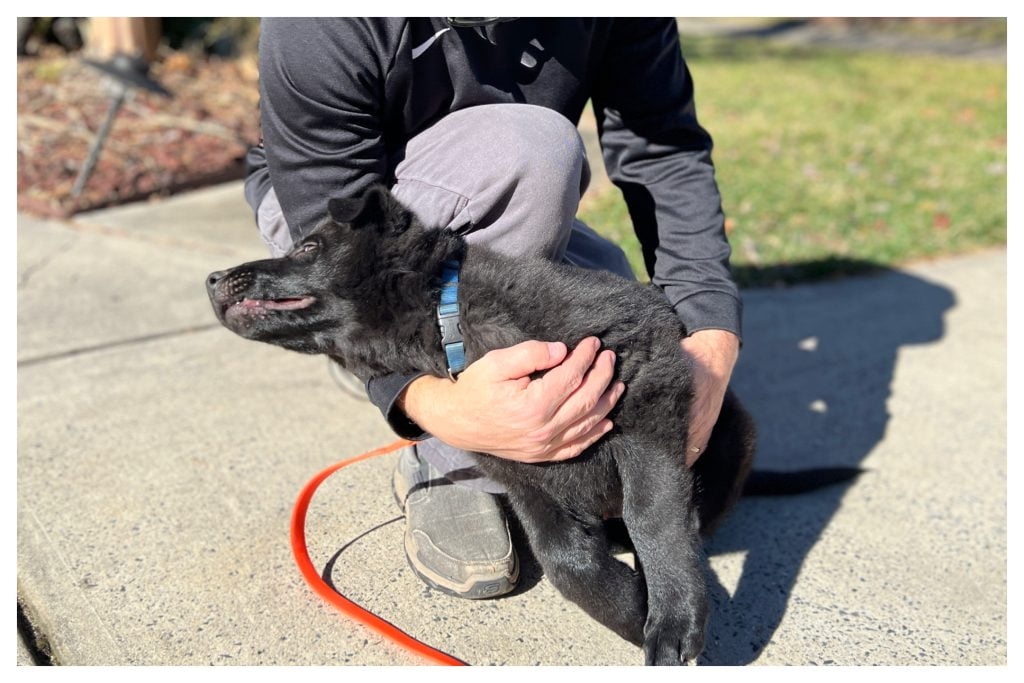
That was the hardest live test in Babe’s whole log, and it’s the standard worth aiming at:
From the training log
“A recall has to work when the dog is in the middle of something he finds pleasure-able.”Babe · Day 23 · 11 weeks 1 day old
What do you do on the day it fails anyway?
It will. Here’s ours, in full, because a protocol you only ever see working is a sales pitch.
Day 33. Babe is twelve weeks and four days old. His recall is proofed — he’d been at 100% for two weeks. A man walks past on the sidewalk. Babe watches him. And then:
From the training log
“It took the walker a good 30 seconds to ‘leave Babe’s airspace’ – as soon as he did Babe was off after him!”Babe · Day 33 · 12 weeks 4 days old
Thirty seconds of a dog visibly loading up, and the whistle never got blown. Not once. Read the next line from that same session and you’ll see who got blamed:
From the training log
“I could have hit him with a whistle recall and he would frozen, done a U turn and blaze back.”Babe · Day 33 · 12 weeks 4 days old
The cue worked. The handler didn’t use it. That’s the honest anatomy of most recall failures, and it’s why “my dog won’t come when called” is so often a timing problem wearing an obedience costume. Call before your dog commits, not after. Once the chase has started you’re no longer competing with a jogger — you’re competing with a dog who is already running, which is the single most reinforcing thing a dog can be doing.
And when a session goes badly, the response is not to drill it harder. Six days earlier, a different failure:
From the training log
“Today was Babe’s first time at a big time failure… Part of his failure was my lack of ability to be clear with what I wanted… So what do you do in this scenario? Reset.”Babe · Day 27 · 11 weeks 5 days old
Reset. Back up to a version the dog can win, get two clean reps, stop. And watch for frustration, because a frustrated dog stops offering behavior and starts flailing:
From the training log
“He kept sampling different behaviors looking for what was correct instead of waiting for the command. This resulted in frustration for him. He was whining and looking for things to chew like the grass or bricks.”Babe · Day 32 · 12 weeks 3 days old
That’s what a cue going bad looks like from the inside — confusion turning into frustration, frustration turning into an association you didn’t want. The plan written down for the next session is the whole lesson:
From the training log
“Next session I will make sure it’s more fun and less frustrating for him so that he will have a good mix and not start to associate frustration with the sessions.”Babe · Day 32 · 12 weeks 3 days old
How long does it take to fix a poisoned recall?
It depends almost entirely on how much history is on the old word and how much wildlife your dog has access to. Rough honest numbers:
| Situation | Reliable in the yard | Trustworthy in public |
|---|---|---|
| Puppy under 6 months, mild poisoning | 2 weeks | 6–8 weeks |
| Adult dog, one clear cause (park always ends) | 3 weeks | 8–12 weeks |
| Adult dog, years of repeating and scolding | 4–6 weeks | 3–6 months |
| High prey drive breed with a rehearsed chase habit | 4 weeks | 6 months, sometimes never fully off leash |
| Adolescent, 6–14 months, in the independence phase | 3–4 weeks | Expect a dip and a rebuild — plan for 4–6 months |
That last row deserves a flag. Adolescence undoes things temporarily, and it is not a sign your training failed.
An honest limit on what this article can tell you. Babe’s log runs 39 days and ends at 13 weeks 3 days old, so every number above about adolescence comes from our wider training experience, not from his record. What his log does show is the earliest visible edge of it — at 12 weeks and 6 days: “As he is getting older he is becoming more independent. Meaning he’ll spend more time away from me sniffing or exploring.” If your dog is eight months old and falling apart, that’s normal, it’s temporary, and the protocol above is still the answer. Go back to the long line and stop testing.
What if my dog only ignores me outside?
Then your dog hasn’t generalized the cue, which is completely normal and slightly humbling: dogs learn in context, not in concepts.
A cue learned in the kitchen is, to your dog, a kitchen cue. Same word in the backyard is genuinely a different problem — different smells, different light, different floor under their feet. This isn’t stubbornness and it isn’t “he knows it, he’s just choosing not to.” He knows the kitchen version.
The fix is unglamorous. Retrain the cue, briefly, in every new place. Five easy reps in the yard. Five in the driveway. Five at the edge of the park before you go in. Five at your parents’ house. Each one takes ninety seconds and each one buys you a location.
Aim for five distinctly different environments before you call the cue generalized. That’s when dogs start to grasp that the whistle means the same thing everywhere — and that’s also the moment it starts feeling like magic, because you’ve done the boring work that makes it look effortless.
The 6 rules that keep a rebuilt recall clean
Tape these to the fridge. Every one of them is a way a cue dies.
- One cue, once. Never repeat it. If you don’t get a response, go get the dog and pay them anyway.
- Never call for something unpleasant. Bath, nail trim, medication, vet, crate at bedtime — walk over and get your dog instead. Use their name, or nothing.
- Never punish an arrival. However late, however annoying. The arrival is the behavior you want and it always gets paid.
- Call ten times, release nine. The recall must predict freedom far more often than it predicts the end of freedom.
- Never call what you can’t back up. No line, no control, no confidence? Don’t blow the whistle.
- Never let the cue go unpaid forever. Thin the schedule, never empty it.
The through-line: the cue is a bank account. Every clean, paid repetition is a deposit. Every ignored call, every leash clip on arrival, every irritated repeat is a withdrawal. Most people don’t have a bad dog — they have an overdrawn word.
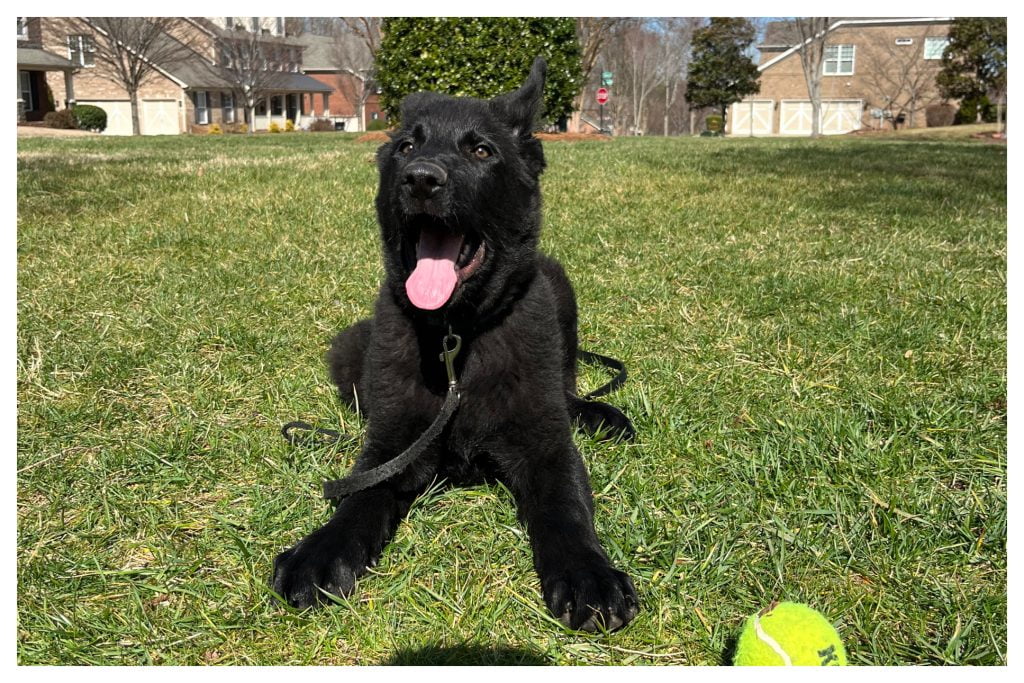
Two days after the walker incident, in an open field, at maximum distance, the log records the last recall of the program — and the reason the whole thing was built the way it was:
From the training log
“I got to the road and he was off sniffing under a tree on the other side of the training field. I hit him with a whistle recall and his response was as expected: instantaneous. This is the reason we teach a whistle recall so early – on their first day!”Babe · Day 35 · 12 weeks 6 days old
Frequently asked questions
Can you fix a poisoned recall cue, or do you need a new word?
Use a new one. A poisoned cue can be improved but the old history stays buried underneath and tends to resurface under pressure — which is exactly when you need the recall to hold. Building a fresh cue takes about a week to charge and costs you nothing, so there is no good reason to fight the old word.
How do I know if my dog is ignoring me or just doesn’t understand?
Test it with a different sound. If your dog blanks on “come” but sprints over for a kissy noise or a crinkling treat bag, they understand fine — that specific word has been devalued. If they’re unreliable to everything, including in your kitchen with no distractions, the recall was never fully trained and you should start from the beginning.
Is it ever okay to punish a dog for not coming?
No, and the timing is why. Any correction lands on whatever the dog did most recently, which is arriving — so you punish the arrival and teach them that coming back is risky. That produces the classic slow, wide, out-of-reach approach. Pay the arrival every time, however long it took.
Should I use my dog’s name as the recall cue?
No. A name should mean “look at me, information is coming,” and it gets used dozens of times a day for everything from dinner to nail trims, which makes it a poor candidate for a life-saving cue. Keep the name for attention and give the recall its own dedicated signal — a whistle pattern or an unusual word your dog has no history with.
How long does it take to retrain a recall?
Most dogs are reliable in a fenced yard in about three weeks and trustworthy in public somewhere between six weeks and three months. Adult dogs with years of repeating and scolding behind the old word take longer, and high prey drive dogs with a rehearsed chase habit can take six months. The charging phase itself is only five to seven days.
Why does my dog come inside the house but not outside?
Because dogs learn in context, not in concepts — a cue trained in the kitchen is, to your dog, a kitchen cue. Retrain it briefly in every new location: five easy reps in the yard, five in the driveway, five at the park edge. Aim for five distinctly different environments before you consider the cue generalized.
What treat should I use for recall training?
Something better than kibble — hot dog, chicken or cheese. We give training puppies one cut-up hot dog per session. Just as important is the timing of the last meal: leave roughly a three hour window before training so your dog is genuinely hungry enough to work for it.
My dog comes and then runs off again — what do I do?
You’re paying at the wrong moment. Feed the dog while you are holding the harness or have a hand on the long line, not before, and deliver several small pieces one after another so the arrival is a place worth staying. Then release them deliberately with a “go play” so leaving becomes something you grant rather than something they take.
Start tonight, with one thing.
Not the whistle, not the long line, not a plan. One thing: on the next walk, call your dog to you five times in the last ten minutes and let them go again every single time.
That’s it. Five reps. You’re not training a recall yet — you’re paying back the account, and you’ll feel it change inside a week.
Then get the whistle and start the seven days. Babe went from knowing nothing to a reflexive recall off a self-chosen distraction in six days, and to 100% against free exploration in twenty. He wasn’t a prodigy and there was no secret. Somebody just made sure he won every rep, and never once said the word when they couldn’t pay for it.
Your dog isn’t broken and you haven’t ruined anything. You’ve got an overdrawn word and about three weeks of small, boring deposits ahead of you. That’s a much better problem than the one you thought you had.
You can do this.
The whistle method, filmed end to end.
The Whistle Recall Course is 22 video lessons shot with a real puppy — the exact conditioning sequence in this article, from the first pairing to a recall that beats a squirrel. New to it? Start with the full guide to puppy recall training.
See the Whistle Recall Course → Instant access · Works on phone, tablet & computer · Lifetime accessRebuilding a recall goes a lot easier when the rest of the routine is calm — a dog who settles on their own has more to spend on training. If bedtime is still a fight, start with crate training a puppy, then come back to the whistle.
Kim and Zahid Buttar spent over 20 combined years as marine mammal trainers at SeaWorld, conditioning killer whales, dolphins, sea lions, walruses, belugas, otters and seals — animals you cannot leash, force, or bribe into cooperating. They now teach everyday puppy owners the same force-free, marker-based methods through Elite Puppy Training in Lake Norman, North Carolina. Babe’s full 39-day training log is published day by day here.
 Free — no card, no catch
The ebook + 13 training videos. Free.
Puppy Training Secrets and the full video library, from former SeaWorld trainers. Biting, whining, crate, recall — handled.
Get both free →